Rodent activity in Durham homes follows distinct seasonal pressures across local microclimates. In older neighborhoods like Trinity Park, Watts-Hillandale, and Old North Durham, historic stone foundations, brick pier…
Rodent activity in Durham homes follows distinct seasonal pressures across local microclimates. In older neighborhoods like Trinity Park, Watts-Hillandale, and Old North Durham, historic stone foundations, brick pier crawlspaces, and aging fascia boards settle over decades, creating access points along sill plates. Norway rats exploit plumbing penetrations around sewer connections and crawlspace vents, while roof rats navigate mature hardwood canopies near Sarah P. Duke Gardens and Duke University West Campus to drop onto ridgelines and slip into attic soffit returns. Further south near Southpoint and suburban tracts in Brightleaf at the Park, settlement around vinyl siding corner posts, HVAC line-set chases, and weep screeds gives house mice entry into conditioned drywall cavities. Exclusion stops nocturnal wall scuttling, food pantry contamination, and wire gnawing at the building envelope before animals access insulation.
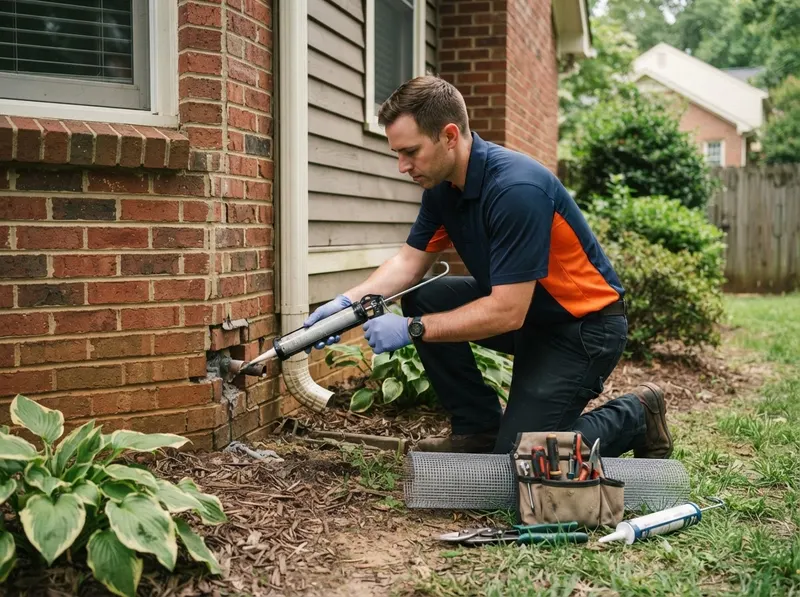
Mechanical exclusion functions as a physical building barrier, resolving the core failure of repetitive retail trapping and anticoagulant baiting. Hardware store baits do not repair structural holes; baiting alone draws continuous waves of rodents inward while risking secondary poisoning to household pets or leaving target pests to expire inside wall bays, generating foul odors and fly infestations. Exclusion pairs heavy-gauge materials with biological necessity: house mice squeeze through gaps measuring 1/4 inch (the diameter of an ordinary pencil), and adult rats enter openings of 1/2 inch. Proper exclusion work secures crawlspace access covers, replaces torn woven-wire foundation grates with 1/4-inch 23-gauge galvanized hardware cloth, and caps roof architectural transitions using custom-bent aluminum coil stock.
Implementation follows a three-step perimeter defense sequence. First, technicians perform a structural ground-to-roof audit, identifying rub marks, gnaw damage, droppings, and thermal drafts around the building shell. Second, workers install durable exclusion materials, securing pipe entries with stainless steel mesh sleeves encased in poly foam, anchoring foundation vent screens with concrete masonry screws, and locking chimney or ridge caps against squirrel entry. Third, internal suppression runs for 7 to 14 days using secured mechanical traps inside crawlspaces and attics to eliminate any rodents trapped inside during sealing. The primary trade-off rests between short-term retail poison purchases and upfront structural repairs; sealing requires an initial investment starting at $250 but removes the health risks and compounding costs of multi-year monthly chemical subscriptions.
Every job gets a firm, written price after a free on-site visit.
Tell us about your residential rodent exclusion job in Durham and we'll send a clear, written quote, usually the same day.
 HomeFort Pest Control