Carpenter ant structural control in Durham, NC addresses a biological threat distinct from termite activity. Carpenter ants do not consume cellulose; they excavate galleries inside damp studs, subfloors, and headers to…
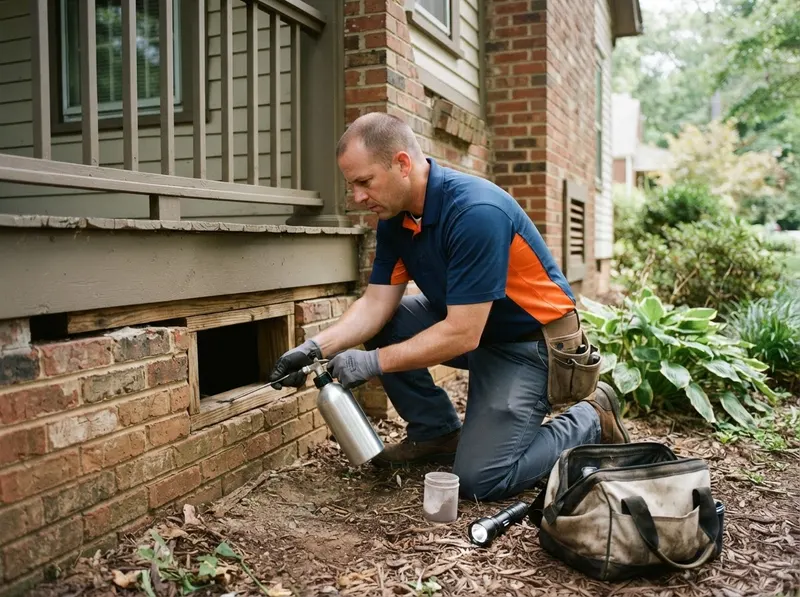
Carpenter ant structural control in Durham, NC addresses a biological threat distinct from termite activity. Carpenter ants do not consume cellulose; they excavate galleries inside damp studs, subfloors, and headers to raise brood, ejecting fibrous sawdust called frass. In mature Durham neighborhoods like Trinity Park, Watts-Hillandale, and Forest Hills, shaded lots and aging oak canopies frequently trap moisture against historic framing. When tree branches overhang rooflines or gutter debris backs up water beneath eaves, parent colonies nesting in tree hollows establish indoor satellite nests inside wall cavities. Retail pyrethroid sprays disperse foraging workers without eradicating the reproductive queen, driving satellite colonies deeper into inaccessible sill plates.
Modern eradication uses localized, non-repellent liquid and micro-dust formulations injected directly into detected wall voids. Workers pass through the treated zone without detection, transferring the active ingredient throughout the colony via grooming within 72 to 96 hours. This targeted application eliminates satellite nests inside crawlspaces and wall assemblies while minimizing airborne residues, ensuring living spaces remain safe for children and pets once the low-odor formulation dries. In newer slab constructions around Southpoint and Brightleaf at the Park, ants often exploit expansion joints or foam insulation panels near outdoor HVAC condensation lines, requiring precision exterior barrier work rather than broad indoor chemical broadcasting.
Property owners evaluating control methods face a direct trade-off between localized colony eradication and whole-structure fumigation. Localized void injection preserves interior finishes and resolves 95% of Durham residential carpenter ant infestations without structural tenting or mandatory subscription plans. The process requires a physical inspection to verify whether active galleries inhabit structural framing or secondary trim, as treating the wood without correcting the underlying moisture source, such as persistent plumbing leaks or crawlspace humidity exceeding 20%, leaves framing vulnerable to re-infestation.
Every job gets a firm, written price after a free on-site visit.
Tell us about your carpenter ant structural control job in Durham and we'll send a clear, written quote, usually the same day.
 HomeFort Pest Control